If you've been lying awake at 3 a.m. staring at the ceiling, you're far from alone. Insomnia is one of the most common health complaints across Canada, affecting approximately 1 in 3 Canadian adults at some point in their lives. According to Statistics Canada, nearly 13% of Canadians report having trouble going to sleep or staying asleep most of the time — and those numbers have only climbed since the pandemic.
Poor sleep doesn't just leave you tired. Chronic insomnia is linked to increased risks of anxiety, depression, cardiovascular disease, weakened immunity, and reduced workplace productivity. When sleep hygiene tips, relaxation techniques, and over-the-counter remedies stop working, many Canadians turn to prescription sleep medications for relief.
Two of the most commonly prescribed sleep aids in Canada are Zopiclone and Zolpidem. Both are effective, both are widely used, and both come with important considerations you must understand before taking them. In this guide, we break down every key difference — from how fast they work to how safely you can use them — so you can have a more informed conversation with your doctor or pharmacist.
Zopiclone is a non-benzodiazepine hypnotic medication belonging to the cyclopyrrolone drug class. It has been available in Canada since the late 1980s and remains one of the most frequently prescribed sleep medications by Canadian physicians today. You'll find it sold under brand names such as Imovane and Rhovane, along with several generic versions.
Zopiclone works by enhancing the activity of GABA (gamma-aminobutyric acid), the brain's primary inhibitory neurotransmitter. By binding to GABA-A receptors, Zopiclone slows down brain activity, calms the nervous system, and promotes sleep. Unlike older benzodiazepines, it is more targeted in its action — though it still carries similar risks with long-term use.
Standard adult dose: 5 mg to 7.5 mg taken orally, just before bedtime.
Elderly patients (65+): 3.75 mg starting dose (lower due to increased sensitivity)
Duration: Recommended for short-term use only — typically 2 to 4 weeks.
Zopiclone is a Schedule IV controlled substance in Canada and requires a valid prescription from a licensed physician or nurse practitioner.
Zolpidem is also a non-benzodiazepine hypnotic, but it belongs to the imidazopyridine drug class. While it is the most prescribed sleep medication in the United States (sold as Ambien), it is also available in Canada under brand names such as Sublinox (sublingual tablet) and some generic formulations.
Zolpidem targets GABA-A receptors similarly to Zopiclone, but with greater selectivity for the alpha-1 subunit, which is primarily responsible for sedation. This selective action is why Zolpidem is considered slightly more targeted — though in practice, the clinical differences are modest.
Like Zopiclone, Zolpidem is a Schedule IV controlled substance in Canada and requires a prescription.
|
Feature |
Zopiclone |
Zolpidem |
|
Drug Class |
Cyclopyrrolone |
Imidazopyridine |
|
Canadian Brand Names |
Imovane, Rhovane |
Sublinox |
|
Standard Dose |
5 mg – 7.5 mg |
5 mg – 10 mg |
|
Onset of Action |
30 – 60 minutes |
15 – 30 minutes |
|
Duration of Effect |
6 – 8 hours |
6 – 8 hours |
|
Half-Life |
5 – 6 hours |
2 – 3 hours |
|
Best For |
Falling & staying asleep |
Falling asleep quickly |
|
Next-Day Grogginess |
Moderate |
Low to moderate |
|
Availability in Canada |
Widely available |
Available (less common) |
|
Controlled Status |
Schedule IV |
Schedule IV |
Speed matters when you're lying in bed, exhausted but unable to sleep. Here's how the two compare:
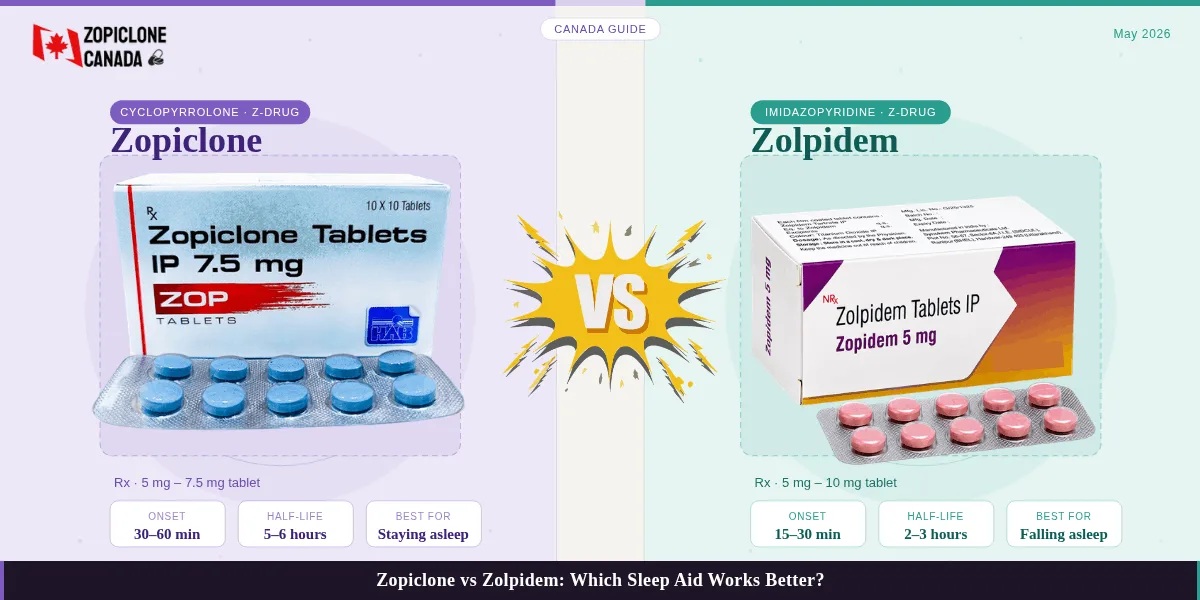
Zolpidem kicks in faster — typically within 15 to 30 minutes of taking it. This makes it the preferred option for people whose primary complaint is taking too long to fall asleep (sleep onset insomnia). It's also available in a sublingual (under-the-tongue) form called Sublinox in Canada, which absorbs even more rapidly.
Zopiclone takes slightly longer to work — usually 30 to 60 minutes — but it has a longer half-life of 5 to 6 hours compared to Zolpidem's 2 to 3 hours. This means Zopiclone stays active in your system longer, making it a better choice for people who wake up frequently throughout the night (sleep maintenance insomnia).
Bottom Line:
Wake up during the night? → Zopiclone
Can't fall asleep at all? → Zolpidem
Both medications have strong clinical evidence supporting their use for short-term insomnia. Multiple randomized controlled trials have found that both Zopiclone and Zolpidem significantly:
Reduce sleep latency(time taken to fall asleep).
Increase total sleep time.
Reduce nighttime awakenings.
Improve subjective sleep quality.
A review published in the Canadian Journal of Psychiatry noted that both drugs show comparable efficacy for short-term insomnia treatment, with no strong evidence that one is definitively superior to the other in healthy adults.
However, there are nuances worth noting:
Both drugs can reduce REM sleep (the deep, restorative phase) with prolonged use — which is why long-term use is strongly discouraged by Health Canada
⚠️ Health Canada Warning: Zolpidem has been associated with next-morning impairment, particularly in women, and with rare but serious complex sleep behaviours including driving while not fully awake. Health Canada recommends women take the lowest effective dose (5 mg) for this reason.
Both medications can cause rebound insomnia — a temporary worsening of sleep — when stopped abruptly.
This is one of the most important sections to understand before starting either medication.
Both Zopiclone and Zolpidem carry a real risk of physical and psychological dependency, even when taken as prescribed. In Canada, this risk is taken seriously — both drugs are tightly regulated, and most physicians will not prescribe them for more than 2 to 4 weeks without reassessment.
How to Stop Safely:
Never stop either medication abruptly. Work with your doctor to taper the dose gradually over several weeks. Combining tapering with Cognitive Behavioural Therapy for Insomnia (CBT-I) — which is available through many Canadian health networks — significantly improves outcomes.
Both drugs must be used with great caution in older adults. The Beers Criteria — a widely used guide in Canadian geriatric care — lists both Zopiclone and Zolpidem as medications to avoid in older adults due to significantly increased risks of:
If a sleep aid is necessary for a senior, the lowest possible dose for the shortest duration is essential.
Neither drug is recommended during pregnancy. Both cross the placental barrier and have been associated with neonatal withdrawal symptoms. They also pass into breast milk. Always consult your OB-GYN before taking any sleep medication while pregnant or nursing.
Zopiclone is metabolized by the liver. Patients with liver disease may experience elevated drug levels and prolonged sedation. Dose reduction is required.
Both drugs suppress respiratory function and are contraindicated in people with untreated obstructive sleep apnea. If you snore heavily or have been told you stop breathing during sleep, speak to your doctor before using either medication.
Both medications interact dangerously with:
Many Canadians struggle with insomnia that is directly driven by anxiety, stress, or depression. In these cases, the choice of sleep aid becomes even more nuanced.
Zopiclone tends to have a slightly broader calming effect due to its less selective binding to GABA receptors, which may offer mild anxiolytic (anti-anxiety) benefits alongside sleep induction. This makes it a slightly more common choice among Canadian physicians for patients with co-occurring anxiety and insomnia.
Zolpidem, while effective for sleep, is more selectively sedative and offers less anxiolytic benefit.
However, it is critical to understand that neither drug treats the root cause of anxiety. For anxiety-driven insomnia, Canadian clinical guidelines strongly recommend CBT-I and, if necessary, an appropriate antidepressant or anti-anxiety medication alongside — or instead of — a sleep aid.
Zopiclone is far more commonly prescribed in Canada. It has been available here for decades and is the sleep medication most Canadian GPs reach for first.
Zolpidem's shorter half-life means it clears your system faster, which may mean less morning grogginess — though this varies by individual.
No. Never switch, stop, or adjust your sleep medication without consulting your doctor or pharmacist first.
Both are approved for short-term use only (2–4 weeks). Long-term nightly use significantly increases dependency risk and is not recommended by Health Canada.
Coverage varies by province. Zopiclone generics are covered under many provincial formularies including Ontario's ODB and BC's PharmaCare. Check with your provincial health authority or pharmacist for your specific coverage.
Yes. CBT-I (Cognitive Behavioural Therapy for Insomnia) is endorsed by Health Canada and the Canadian Sleep Society as the most effective long-term treatment for insomnia — with results that outlast medication.
|
Your Sleep Problem |
Recommended Option |
|
Can't fall asleep quickly |
Zolpidem |
|
Wake up multiple times at night |
Zopiclone |
|
Anxiety + sleep issues |
Zopiclone |
|
Need to minimize morning grogginess |
Zolpidem |
|
Long-term solution |
CBT-I Therapy |
Both Zopiclone and Zolpidem are effective, well-studied sleep aids that can offer genuine relief from short-term insomnia. Neither is universally "better" — the right choice depends on your specific sleep pattern, health history, age, and other medications you take.
The most important step? Talk to your doctor or a licensed Canadian pharmacist. They can review your full health picture and prescribe the most appropriate option — or help you explore non-drug paths that may serve you better in the long run.
Because the best night's sleep is one you wake up from feeling truly refreshed — not just sedated. 😴
This article is intended for informational purposes only and does not constitute medical advice, diagnosis, or treatment. Always consult a qualified healthcare professional — including your physician, nurse practitioner, or licensed pharmacist — before starting, changing, or discontinuing any prescription medication. Drug regulations, coverage, and clinical guidelines may vary by province. Information reflects general Canadian health guidance as of May 2026.
Please log in to add a comment.


Dr. Sarah Bennett brings a fresh voice to our pharmacy’s blog. With a strong background in clinical medicine and public health, she is committed to translating trusted medical knowledge into clear, useful information for everyday readers.
.svg)
Delivered in secure, plain packaging on fully tracked delivery from just $15CAD.

Our team of doctors and pharmacists, and our support staff, are all Canada-based.
.svg)
Have a question? Telephone support is always free; Monday - Friday, 9am - 5pm.

Comments........!